
Share Walter John Heikkila's obituary with others.
Invite friends and family to read the obituary and add memories.
Stay updated
We'll notify you when service details or new memories are added.
You're now following this obituary
We'll email you when there are updates.
Select your format and elements to print

IN LOVING MEMORY OF Walter John Heikkila
Walter John
Heikkila
Feb 22, 1928 — Oct 1, 2024
Walter John Heikkila's Obituary
Walter Heikkila (Heikkilä, in Finnish) emerged from his early years in the isolated reaches of northern Ontario, Canada, to eventually become a noted professor of physics, a world traveler, and a great-grandfather several times over. The son of Kustaa and Amalia Heikkila, and older brother to sister Raili, Walter's boyhood was, in retrospect, the stuff of fables. Indeed, that fabulous story was the basis for a 1993 documentary film by Vaughan Killin, "A Dream Worth Living: The Story of Kustaa Heikkila", that was aired nationally by the Canadian Broadcasting Corporation. In such a pristine setting, the northern lights are truly spectacular, so perhaps Walter was pre-destined to later become the world's foremost expert on the aurora borealis.
Walter performed exceptionally well in school, skipping two grades. At his father's urging, he then applied to and was accepted by the University of Toronto, Canada's premier institution of higher learning, where he went on to earn his Ph.D. in physics. Toronto also had a lively Finnish-Canadian community, and that is where he met Aura Katajisto, born in 1935, whom he married in 1953. They settled in Ottawa, the nation's capital, where sons Eric (1955) and Richard (1958) were born. A proverbial "rocket scientist", Walter worked at the Defense Research Telecommunications Establishment, where he led the Rocket Section.
In 1963, Walter was courted by the University of Colorado at Boulder, the University of California at San Diego, and the Southwest Center for Advanced Studies in Dallas. He accepted an offer from the latter, which was the institutional embryo for the University of Texas at Dallas. It was there, at UTD, that he spent many decades of research and teaching, eventually becoming Professor Emeritus. He took great pride in the Ph.D. students whom he supervised, including W.D. Bunting Jr. (1970), David Winningham (1971), J.R. Sharber (1972), J. Tarstrup (1972) and Risto Pellinen (1979). It was during this period that he began to formulate the theoretical work that became the foundation of his singular perspective on the earth's magnetosphere.
The transition from Ontario to Texas was not easy in all respects. Sadly, Walter's wife, Aura, died in 1967, leaving behind a bereft husband and two sons. Walter remarried briefly before meeting Jeanine (née) Besson, whom he married in 1977, not long after he suffered a debilitating stroke. They remained together for the rest of their long lives, and Walter's extended family by then included Jeanine's children from a prior marriage: Susan, Philip and Paul. Collectively, Jeanine and Walter thus had five children, seven grandchildren and four great-grandchildren. Sailing became a passion that Walter and Jeanine shared for many years, and that surely gave them many of their happiest memories together.
When Walter joined the UTD staff, the field of magnetospheric physics was just emerging. Research satellites providing vital new information had been introduced a few years earlier, and Walter became the leading scientist of a particle instrument of the Canadian satellite ISIS-1 launched in early 1969. The data derived from this project led him and his co-workers in 1970 to discover the cusp (cleft) in the magnetosphere that became the grand basis of almost all of his future theoretical work. By 1973 he was able to draw a three-dimensional picture of the entire magnetosphere with all its various plasma layers. That picture made his name world-known and has been copied in its original and various modified forms in numerous review publications and textbooks.
In his scientific work Walter always had a few basic principles: Thinking in three dimensions and basing physical arguments on Newton's laws in mechanics and Maxwell's equations in electrodynamics. He always emphasized investigating the cause and effect (or dynamo and load) relationship in various processes. The main subject was particle energy transfer from the solar wind into the magnetosphere and energization processes within the magnetosphere. One of the main questions was how the electrons responsible for production of the auroral light gain energy after being trapped on the magnetic field lines. According to his judgement, rapid local changes in the magnetic field create inductive electric fields responsible for effective electron acceleration leading to dynamic auroral forms visible in the earth's polar regions.
Walter was the first author of numerous scientific publications dealing with almost all questions and problems of modern magnetospheric physics. His drawings and diagrams, most of them in 3D, have become essential elements for describing magnetospheric processes. He actively and consistently drew upon the results of current satellite observations that in turn confirmed many of his most fundamental views. While some of his arguments have been questioned, he has always had strong physical explanations defending his views.
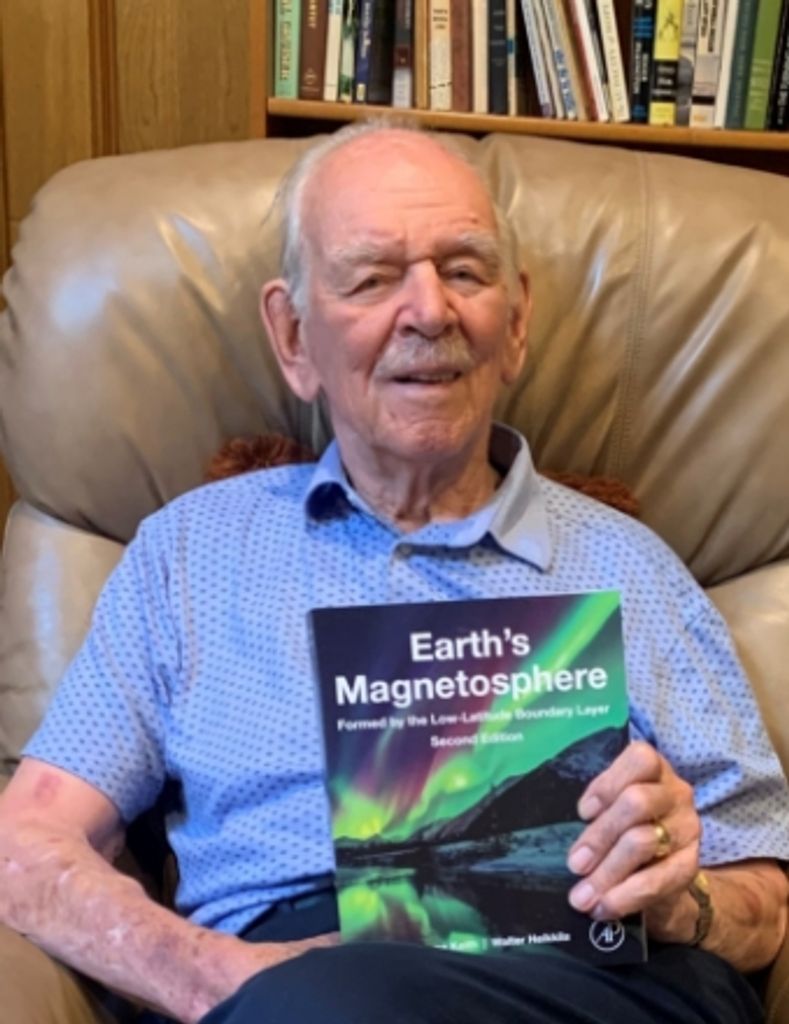
Although he retired officially in 1995, Walter never lost his passion for scientific work. Indeed, he published his first book in 2011 at the age of eighty-three. With a title that only a fellow space scientist could love (Earth's Magnetosphere: Formed by the Low-Latitude Boundary Layer), it provided a comprehensive overview of his field and is a brilliant summary of his key ideas regarding magnetospheric processes and the creation of the aurora borealis. It was followed by a second edition that was published when Walter was ninety-two. His co-author on this second edition, Professor Wayne Keith, is Walter's "scholarly grandson", insofar as his Ph.D. advisor (David Winningham) was himself one of Walter's Ph.D. advisees.
Walter Heikkila (Isä, as he was known to many family members) was a very good man. He loved life; he loved his family; and he loved his science. His scientific and personal legacies will live on as his great- grandchildren grow and thrive, and as his path-breaking theories about the earth's magnetosphere gain ever-wider recognition and attest to his intellectual courage and imagination. When those of us who love him look to the northern sky, it will always shine bright with his memory.
Funeral Services for Walter John Heikkila
Memorial Service

Thursday
Aria Cremation Services and Funeral Home
Starts at 1:00 pm
Walter John Heikkila's Guestbook
Visits: 11
This site is protected by reCAPTCHA and the
Google Privacy Policy and Terms of Service apply.
Service map data © OpenStreetMap contributors